
About this page
You don’t have to read the pack all at once, you can read it at your own pace. This information has been developed to be accessible for a range of reading ages and needs.
If you have feedback about this page and suggestions of how we can make it more accessible, you can tell us by emailing spft.camhsparticipationteam@nhs.net.
What will therapy with CAMHS involve?
Following your assessment, you and your assessment clinician agreed that treatment for Anxiety would be most helpful for you.
You will have been offered one of these therapies:
- Cognitive Behavioural Therapy (CBT)
- Child Psychotherapy
- Family and Systemic Psychotherapy
Cognitive Behavioural Therapy (CBT) for anxiety
CBT (Cognitive Behavioural Therapy) is a talking therapy which helps you to understand how your thoughts, behaviour and feelings are connected. It will help you to learn how to think and act in ways that will improve how you feel, and reduce your anxiety.
How many sessions will I have?
- You will have up to 18 sessions.
- You might have one-to-one sessions or group sessions.
- Sessions may be in-person or online.
- CBT will be adapted to suit your age and needs.
- Your parents and carers may join some or all sessions.
Working with your clinician
CBT involves working collaboratively with your clinician. You will talk about your difficulties and find solutions for these. This work may involve experiments to challenge your thinking and behaviours and testing these out both in sessions and between sessions. You will have regular reviews with your clinician to make sure this approach is working for you.
British Association for Behavioural and Cognitive Psychotherapies - What is CBT?
This video explains what CBT is and how it can help you. Older children, teenagers and parents and carers may find this helpful. This video is 1 minute.
Mental Health Center Kids - What is CBT? CBT Tools - Catch, Check, Change
This video explains what CBT is and how it can help you. Younger children may find this helpful. This video is 4 minutes 31 seconds.
Mental Health Center Kids - Cognitive Behavioural Therapy for Kids, Thoughts Feelings, Actions
This video explains what CBT is and how it can help you. Younger children may find this helpful. This video is 4 minutes 7 seconds.
What is Graded Exposure?
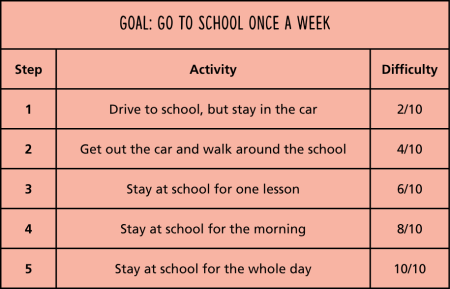
Your therapy will also involve Graded Exposure. This will help you to face the situation/object you are avoiding by gradually helping to break the cycle of anxiety. There is an example below.
This may feel scary, but your therapy is collaborative. So you won’t be forced to do something you don’t want to do or that you aren’t ready to do. It will be built up slowly at your pace. Equally, your therapist will support you if you want to push and challenge yourself during therapy.
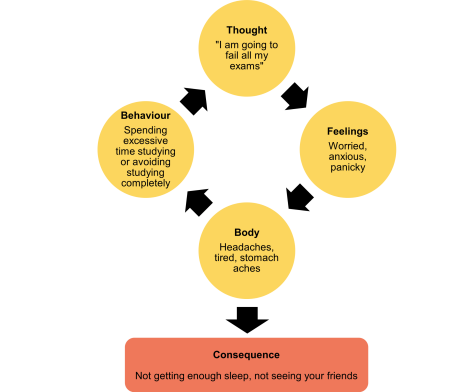
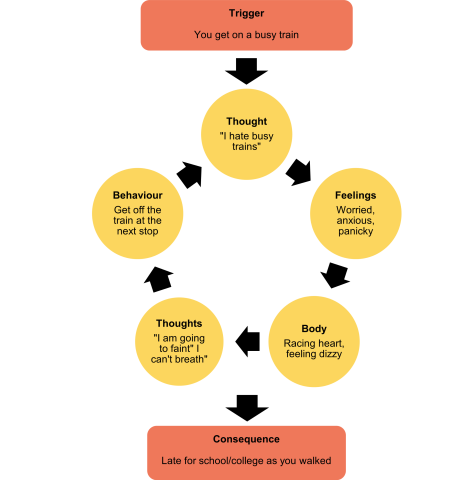
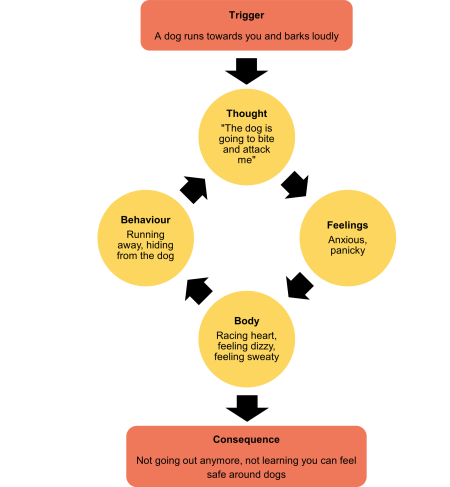
The cycle of anxiety shows how your thoughts, feelings and behaviour are linked. There are examples below.
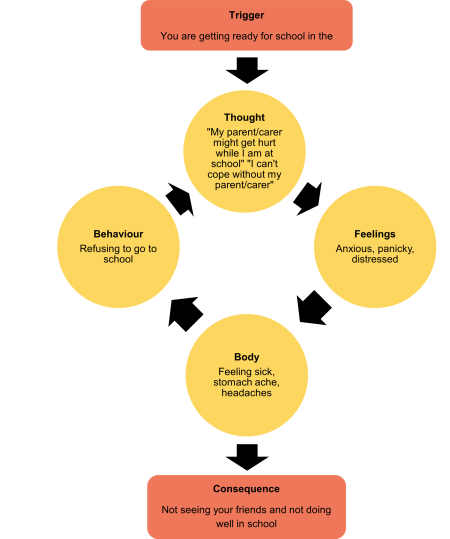
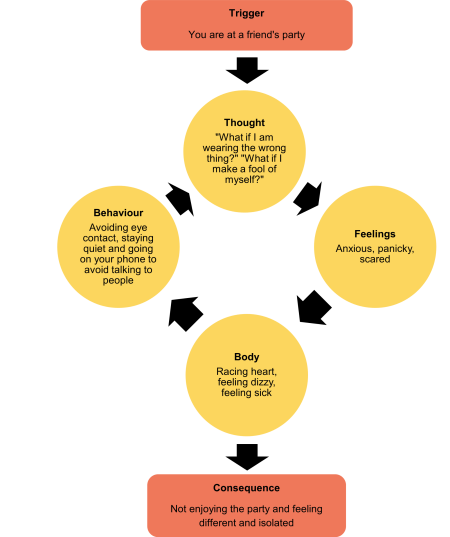
What are safety behaviours?
You will practice challenging your safety behaviours. Safety behaviours are things you do protect yourself from your anxiety triggers.
You might avoid certain things, seek reassurance or distract yourself. These help you feel less anxious, but can make your anxiety worse in the long term. Below are some examples of safety behaviours. You may do some, all or none of these, that is okay, everyone experiences anxiety differently.
Your parents, carers and anyone you trust can help you to practice challenging your safety behaviours.
Examples of safety behaviours
- Not leaving the house
- Going on your phone when socialising
- Staying close to exits
- Avoid certain objects or situations e.g. getting an injection or going on public transport
- Repeatedly checking things
- Repeatedly asking your parents, carers or friends for reassurance
The therapies we offer in CAMHS have been tested and proven to help. You have been offered CBT as this is the best way to know how to help children and young people feel less anxious.
If you would like more information about this, Anna Freud have created guides which explain different treatment and why you have been offered them for anxiety. This document explains:
- What is Anxiety?
- How can I get help?
- When and why you will be offered different therapies?
- The evidence behind each type of therapy for treating Anxiety
Child Psychotherapy for anxiety
Child Psychotherapy is a talking therapy that can help you to understand yourself and your anxious thoughts better.
You might explore your emotions and behaviours by looking at what has happened in your life and your relationships with family, friends and other important people.
How many sessions will I have?
- You will have up to 30 sessions.
- These will be one-to-one sessions.
- Sessions may be in-person or online.
- Sessions will be adapted to suit your age and needs.
- Your parents and carers may join some or all sessions.
Working with your clinician
Working closely with your clinician, together, you might try to better understand patterns that you may have not been aware of and coping strategies you may have developed. This can help you to understand yourself better and help you to make better choices.
Your clinician may also work with your parents, carers and family members to support the work you are doing with your clinician
You will have regular check ins with your clinician to make sure the therapy is working for you.
- Line about rationale for this over CBT
- May have already tried CBT and not helped
If you would like more information about this, Anna Freud have created guides which explain different treatment and why you have been offered them for anxiety. This document explains:
- What is Anxiety?
- How can I get help?
- When and why you will be offered different therapies?
- The evidence behind each type of therapy for treating Anxiety
What is Family and Systemic Psychotherapy for anxiety
Within family & systemic psychotherapy sessions you will be supported to explore your relationships within your family (who ever your family is to you, including friends) and the possible effects the anxiety is having within those relationships.
Some times patterns are created around anxiety and our family/friends can support us to notice and challenge patterns that no longer work for us. Exploring the family communication surrounding the anxiety is usually helpful for all the family members.
Looking at wider support networks and how to continue positive changes is also what your family & systemic psychotherapist can explore together.
How many sessions will I have?
- You will have up to 12 sessions.
- These will be sessions with your family and carers.
- Your sessions may be in-person or online.
- Sessions will be adapted to suit your age and needs.
- Line about rationale for this over CBT
- May have already tried CBT and not helped
- Need this alongside CBT to help CBT work
If you would like more information about this, Anna Freud have created guides which explain different treatment and why you have been offered them for anxiety. This document explains:
- What is Anxiety?
- How can I get help?
- When and why you will be offered different therapies?
- The evidence behind each type of therapy for treating Anxiety
In Family and Systemic Psychotherapy, 'Family' refers to anyone you care about and who cares about you. It doesn't just mean someone who is biologically related to you, so 'Family' also refers to:
- Step-parents
- Step-siblings
- Carers
- Adopted & foster siblings.
Read more information about this on the Association for Family Therapy and Systemic Practice.
How is my therapy going?
You and your therapist will have regular conversations about how you are finding therapy. These are called review sessions, we will do a review session after every 6 therapy sessions.
If you feel it’s not working, you can tell your clinician in your review sessions. But you can also do this any other time that you would like to. We encourage you to be honest with your therapist. Hearing your feedback helps your therapist to understand what does and doesn't help you.
Your parents and carers might join these sessions, if you and your clinician think that is a good idea. You can tell your clinician if you don't want your parents and carers in your review sessions.
During your review sessions, you and your clinician will think about:
- How therapy is going
- Your goals and if therapy is helping you work towards these goals
- If you need support from other services. This could be services within CAMHS or outside of CAMHS.
Together you will:
- Update your care and/or safety plans
- Update your risk assessment
- Complete questionnaires to track your progress, you can read more about this on our Tracking Your Progress page
- Plan next steps e.g. for therapy, starting to a different therapy, moving on from CAMHS.
Sometimes reviewing how your therapy is going involves your clinician talking to other clinicians in their team. This will happen in Multi-Disciplinary Team (MDT) meetings.
MDT meetings help your clinician think about you and your difficulties in different ways and what your next step might be. Your clinician will always share what was discussed in MDT meetings with you and use this to plan your next steps with you.
Any discussions held about you in MDT meetings are respectful and confidential.
Making treatment feel easier
We will adapt your therapy to suit your age and and needs.
We encourage you or your parents and carers to talk to your clinician about adjustments you may need. We will make adaptations to support you to engage with the therapy we offer.
It is okay if you don’t know what adjustments you need or these change as you progress through therapy. You and your clinician will work together to make sure therapy meets your needs.
Below are some examples of adjustments you could ask for:
-
Information to be shared in different formats or languages
-
Breaks during the session so that you can move around
-
Dimming or turning off bright lights
-
Using visuals or writing down your thoughts
More information about my therapy
Children and Young People
Mind - Cognitive Behavioural Therapy
This website explains:
- What CBT is?
- What CBT treats?
- What CBT sessions are likes?
- How can I get CBT?
- Can I do CBT by myself?
- What if CBT doesn't work for me?
Young Minds - Talking Therapies
This website explains:
- What is talking therapy?
- Common types of talking therapy
- What happens during therapy sessions?
- How to make the most of therapy sessions?
- How to access talking therapy
- Finding the right therapist for you
- Get help now
Parents and Carers
Young Minds - Counselling and therapy
This website link may be helpful for parents and carers to understand:
- How can I get counselling or therapy for my child?
- Finding the right support for your child
- Common types of talking therapies
- Talking to your child about counselling and therapy
- Supporting your child during counselling or therapy
- Looking after yourself
- Useful helplines and websites
Children and Young People
Association of Child Psychotherapists - Information for Young People
This website explains:
- What is Child Psychotherapy is?
- What you might need to know.
Association of Child Psychotherapists - How Child and Adolescent Psychotherapy Can Help
This website explains:
- What is Child Psychotherapy is?
- How can it help?
- Why does it help?
Parents and Carers
Association of Child Psychotherapists
This website explains:
- What is Child Psychotherapy?
- What Child Psychotherapists can help with?
Children and Young People & Parents and Carers
Association for Family and Systemic Psychotherapy
This website explains:
- What is Family and Systemic Psychotherapy?
- Who is Family and Systemic Psychotherapy for?
- What difficulties can Family and Systemic Psychotherapy help?
- Frequently Asked Questions
This website explains:
- What is Psychotherapy?
- Types of Psychotherapy
- How does Psychotherapy work?
- Frequently Asked Questions
Click the link below to find information about NICE guidelines and recommendations for recognition, assessment and treatment for Social Anxiety.