
We recognise the term gender dysphoria can be difficult for some individuals so we are using the term gender incongruence. We know that having a label isn't something that everyone feels okay with but it is necessary to be able to access some of the therapies provided at Sussex Gender Service.

We're an NHS adult gender service pilot in Sussex, which has been commissioned to provide local transgender healthcare for trans and non-binary people.
This includes assessment and diagnosis for gender incongruence, which involves a holistic assessment of an individual's needs and offers referrals and signposting to other services.
About Sussex Gender Service
Sussex Gender Service is staffed by an experienced multi-disciplinary team. We have care navigators with lived experience that work with people who access our services to provide support and signposting to local organisations.
The service follows the same service specification from NHS England as other gender service pilots, which is similar to the existing gender identity clinics.
The service is a three year pilot which started in September 2023. In our third year, we are undergoing an independent evaluation in anticipation of the service being commissioned for a sustained period.
Care pathways
We offer a range of specialist therapies including speech and language therapy, psychological support, referrals for hormone therapy, surgery, fertility preservation and hair-reduction.
We will help support you to make informed decisions about the care pathways you can access. We will be able to explain how you can access support, what you might need to do to prepare, what they will involve, and any potential risks there might be.
Find out more about the care pathways.
We are a team of LGBTQ+ people and dedicated allies working collaboratively to bring together a broad range of expertise and experience. The team is made up of a range of professionals including our administrators, care navigators, nurses, speech and language therapists, psychologists, GPs, service manager and clinical lead. We work closely with our local community of trans, non-binary and intersex people in developing and delivering our service.
Find out more about the roles within the team:
Clinical lead: Provides clinical leadership to Sussex Gender Service and is responsible alongside the service manager for the delivery and implementation of Sussex Gender Service.
Service manager: Responsible for the delivery and implementation of Sussex Gender Service.
Nurses: Provide specialist assessments and follow up appointments with patients as well as access to some interventions.
GPs: Provide specialist assessments and make referrals for hormone therapy, surgery and other interventions/therapy pathways.
Psychologists: Offer therapeutic sessions to patients who are experiencing psychological, emotional or relational distress relating to or linked to their gender identity. They have expertise in working with people who are neurodivergent.
Speech and language therapists: Provide voice coaching to patients.
Admin team: Contact service users and book appointments, process and send letters for the clinical team.
Care navigators: Provide essential practical support and non-clinical advice to individuals who are accessing or wishing to access the service.
Our values at Sussex Gender Service
1. Our service is committed to an intersectional approach
We recognise and acknowledge the historical and ongoing harm that the transgender community experiences. We think very carefully about privilege, power and intersectionality and provide training on this to our team. We do all that we can to take a stand against any form of transphobia.
2. Support is compassionate, respectful and trauma informed
We endeavour to make sure that everyone who comes through Sussex Gender Service has a high-quality service that considers individual needs and adjustments in a sensitive way. We are committed to making sure that everyone can feel comfortable and safe to tell their narrative.
3. Collaboration with service users and our community
Sussex Gender Service has worked hard to involve the trans, non-binary or intersex (TNBI) community in Sussex in the development and mobilisation of the service. This is an ongoing priority for the service. We believe it is important to involve service users of different gender, race, sexual orientation, disability and class.
4. Psychological safety
We aim to create a safe, supportive space for service users to explore their gender journey. We support trans and non-binary people to be well informed about their choices by sharing knowledge and options.
We also consider psychological safety within our team a priority. We encourage team members to be non-judgemental, ask questions and reflect on learning points. We have regular reflective practice in the team.
5. Accountability and learning
We invite feedback about the service and aim to respond to everything that is raised. We acknowledge any mistakes and challenges that occur. We value learning and competencies and this is reflected in the training that all our team members access.
Our vision
This describes our purpose, gives direction for our behaviours and provides inspiration for our work:
A collaborative, respectful and holistic approach, valuing each individual experience, meeting TNBI people where they are in their journey and providing excellent care. We prioritise reflection and learning from our work alongside the input of our community groups.
Our mission
This clarifies our vision and outlines the primary objective of our service:
We provide compassionate, safe, supportive and holistic care to TNBI people to enable them to live as their most authentic selves.
Our admin team are contacting patients who are eligible to transfer to our waiting list. We will be contacting patients in date order. The patients that have been waiting the longest will be contacted first.
We are currently contacting people who were accepted onto a gender clinic waiting list up until January 2023.
To be eligible to join Sussex Gender Service:
- You must be on the waiting list for an adult NHS gender identity clinic
- You must have joined that waiting list prior to 31 March 2023
- You must have been registered with a Sussex GP prior to 31 March 2023
- You must be 17 or older on 31 March 2023
- You must still be currently under the care of a Sussex GP
- You have not had an appointment with another NHS gender identity clinic.
Updated 14th April 2026:
We have now contacted everyone who was transferred to Sussex Gender Service. If you think you should have been transferred, and meet our eligibility criteria, please contact us on spft.sussexgenderserviceinfo@nhs.net.
Waiting times for SGS from point of contact to initial appointment have increased as the number of service users within SGS has increased. We still aim to see all service users contacted to join SGS by September 2026.
Waiting times for our pathways:
Initial appointment: We are contacting people who were originally referred to a GIC in early March 2023.
Second assessment: We are contacting people who had their initial appointment with us in March 2026.
Surgical recommendation: We are contacting people who became eligible for a surgical recommendation in March 2026.
Psychological & wellbeing support: We are contacting people who were added to our waiting list in July 2025.
Voice therapy: We are contacting people who were added to our waiting list in April 2025.
- You can access non-medical support from our care navigators
- Hormones: you may be able to access bridging hormones with a supportive GP. This allows any private hormone treatment you're already accessing to be taken on by the NHS. If you have not started hormones, this allows you to start hormones through the NHS. We would not be able to recommend specific GP surgeries, but it may be worth looking into community recommendations. WellBN has a Trans Health Hub which may be useful to look into if you are struggling to find a supportive GP
- Voice therapy: you may be able to get a referral from your GP for gender affirming voice therapy. If you live in East Sussex here is some information about this: Speech and language therapy
- Support for GPs: if your GP requires any support or advice about your gender affirming care, they are very welcome to come to us with any questions as we can provide training - advice and guidance for all Sussex GPs.
Sussex Gender Service is not an urgent service. We offer psychological and wellbeing support as one of our care pathways, which you may access once you have joined the service and have been seen for your initial appointments. For more urgent help, and for support while you are waiting, please see the resources below.
If your life - or someone else's life - is in immediate danger, please call 999 or go to A&E.
- For same or next day help with your mental health, call NHS 111 and select the mental health option, text the word SUSSEX to 85258.
- Visit a Staying Well service in Sussex. (Weekdays - 5pm to 10.30pm/weekends - 3pm to 10.30pm).
- NHS resources for getting help with your mental health.
Support for trans, non-binary and intersex adults
Care navigators are trans, non-binary or intersex (TNBI) community members employed by The Clare Project who work alongside the Sussex Gender Service to offer people accessing Sussex Gender Service help and advice.
- Call/text: 07464 229395
- Email: carenavigators
@clareproject.org.uk
Switchboard is a national LGBTQIA+ support line.
- Phoneline open 10am to 10pm: 08000119100
Gendered Intelligence offer free support by and for trans/non-binary people by phone, email or WhatsApp chat.
- Available Monday 12-5pm; Tuesday 2-7pm; Wednesday 10-3pm; Thursday 12-5pm; Friday 10-3pm
- Phone: 0800 640 8046
- Email: supportline
@genderedintelligence.co.uk - WhatsApp: 07592 650 496
Support for trans, non-binary and intersex children and young people
Allsorts youth project provides non-judgemental and safe spaces for children and young people to connect, feel heard, valued, and safe.
Once you have transferred to Sussex Gender Service we will invite you to book an appointment.
Our primary method of contact is by email, and we also use SMS text messaging. We may call you, and if we have your mobile number we aim to send you a text message to pre-warn you about the call, which will be from a withheld number. We will send letters by post if you request this.
We offer video appointments on an online platform called Attend Anywhere.
- Attend Anywhere guide for remote appointments
- It is recommended to use the latest version of Chrome, Safari, or Edge internet browser, as there are issues with Firefox
- When you open Attend Anywhere, it will prompt you for your name. Please enter the name you go by; this is just used by your clinician to identify you.
- Once connected you will enter a virtual waiting room where your clinician will join the call. Please ensure that you have a confidential space and that you will not be interrupted.
- During the call your video will be shown on the screen. Some people may prefer not to see their own video and we suggest putting a card or sticky note over your monitor to cover this.
We also offer face-to-face appointments at St Peter's Health Centre in central Brighton.
Please do not attend face‑to‑face if you have cold or flu symptoms, or diarrhoea or vomiting (you must be symptom‑free from diarrhoea or vomiting for 48 hours). Please contact us to arrange a video appointment or reschedule.
There is help available if you need financial support to attend in-person appointments.
We can offer home-visits in certain circumstances.
Our appointment booking system
We use a clinical administrative system called SystmOne, and we use an appointment booking system linked to SystmOne. Usually, we will send you a booking link by email or SMS. You will be able to choose from a range of appointment dates.
Unfortunately, our booking system does not specify which appointments are available in-person or by video. Because of this, all appointments booked using the online booking system are booked as video appointments. The booking confirmation page includes our address at St Peter's Health Centre, however, the appointment will be online.
Once you have booked an appointment on the online booking system, the admin team receives a notification. The admin team will review your booking and send you an appointment confirmation by email, or by post if you have requested this, usually within 1 week. If you would prefer to have an in-person appointment, you can contact us to let us know.
Missed appointments - also known as DNA
A DNA (Did Not Attend) is when a service user does not attend their scheduled appointment and hasn’t let us know at least 24 hours in advance.
We understand that things can come up unexpectedly, and there may be many reasons why it’s hard to attend. However, if we don’t receive notice in time, we’re unable to offer the appointment to someone else who may be waiting for support.
When this happens, we’ll follow our DNA policy to ensure we can continue offering safe and effective care. If you're struggling to attend or need help cancelling or rearranging, please don’t hesitate to contact us — we’re here to support you.
If you miss an appointment without letting us know, here’s what happens:
1. First missed appointment (DNA)
- We’ll send you a message inviting you to opt back in to your care.
- Please contact us within 15 working days to rearrange your appointment.
- If we don’t hear from you in that time, we may need to close your current referral or discharge you from the service.
2. Two missed appointments in a row
- If you miss two appointments in a row and we haven’t heard from you, we’ll contact you letting you know that you’re being discharged from the care pathway or from our service (SGS).
- You’ll always have the option to return in the future if appropriate.
3. If you are already in therapy
- If you’re in active therapy and miss multiple appointments, your lead clinician will be involved in any decision about discharge.
- This will be discussed with the wider clinical team to make sure the best decision is made for your care.
4. Can I return after discharge?
- If you’ve been discharged and would like to come back, please contact us. We’ll look at this on a case-by-case basis to see how we can best support you.
5. If you miss two appointments after opting in
-
If you miss an appointment 3 times in a row, we will send you a final opt-in, after which we will discharge you.
-
Please contact a care navigator or the team if you’re having any difficulties - we want to help.
6. Missing three appointments in a row
- If you miss three appointments without contact, we will discharge you from the therapy pathway or the service.
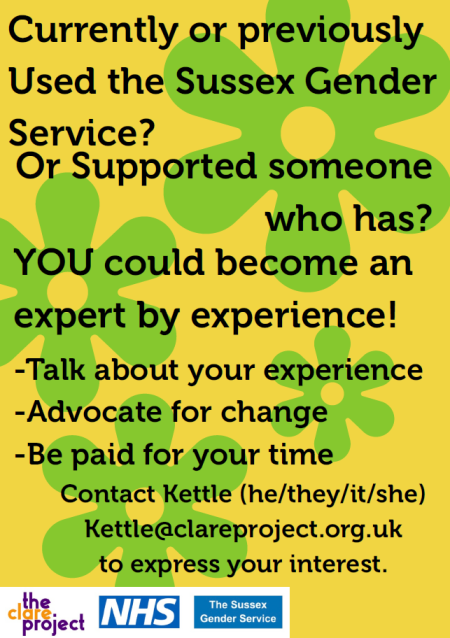
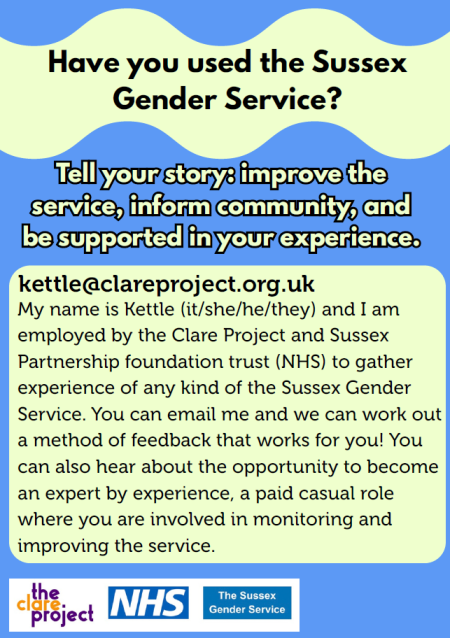
Join the SGS Feedback and information Group. It is an inclusive group comprising of people who have experience of using SGS or being a carer for someone who does. The group provides feedback on positive aspects and any challenges encountered and opportunities to suggest service improvements. Find out more on the SGS Participation Padlet page.
If you'd like to find out how people from the community worked with us to develop Sussex Gender Service, please read our engagement summary.
View previous newsletters below, or join our mailing list.
- Sussex Gender Service newsletter: April 2026
- Sussex Gender Service newsletter: March 2026
- Sussex Gender Service newsletter: February 2026
- Sussex Gender Service newsletter: January 2026
- Sussex Gender Service newsletter: December 2025
- Sussex Gender Service newsletter: November 2025
- Sussex Gender Service newsletter: October 2025
- Sussex Gender Service newsletter: August/September 2025
- Sussex Gender Service newsletter: June/July 2025
- Sussex Gender Service newsletter: May 2025
- Sussex Gender Service newsletter: March/April 2025
- Sussex Gender Service newsletter: January/February 2025
- Sussex Gender Service newsletter: December 2024
- Sussex Gender Service newsletter: November 2024
- Sussex Gender Service newsletter: October 2024
- Sussex Gender Service newsletter: September 2024
- Sussex Gender Service newsletter: August 2024
- Sussex Gender Service newsletter: July 2024
- Sussex Gender Service newsletter: June 2024
- Sussex Gender Service newsletter: May 2024
- Sussex Gender Service newsletter: April 2024
- Sussex Gender Service newsletter: March 2024
- Sussex Gender Service newsletter: February 2024
- Sussex Gender Service newsletter: January 2024
- Sussex Gender Service newsletter: December 2023